The history of Telangana state is long and rich, shaped by geography, rivers, kingdoms, and people’s movements. Telangana has seen ancient settlements, powerful dynasties like the Kakatiyas, Islamic sultanates, Nizam rule, British influence, and finally a long struggle that led to the formation of Telangana as a separate state in 2014.
This page gives a complete, easy-to-understand timeline of Telangana history, from ancient times to the present day. It is written for students, general readers, and anyone searching for reliable information about Telangana’s past.
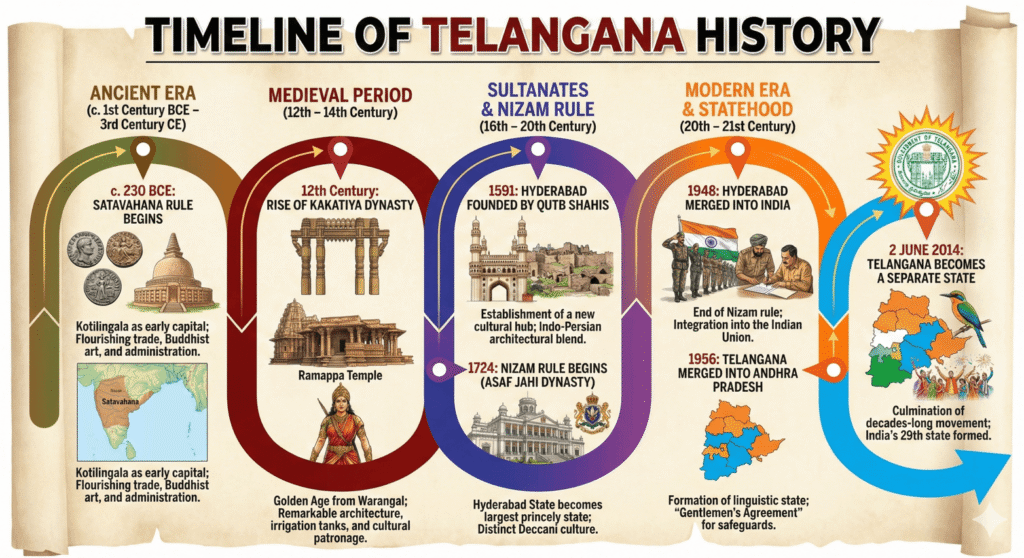
Telangana History Timeline (Quick Overview)
Timeline of Telangana History:
- c. 100,000 BCE – Early human settlements in the Deccan region
- 1st century BCE – Satavahana rule begins
- 12th century CE – Rise of the Kakatiya dynasty
- 1323 – Fall of Warangal and end of Kakatiya rule
- 1518 – Qutb Shahi dynasty comes to power
- 1591 – Hyderabad city founded
- 1724 – Beginning of Nizam rule
- 1948 – Hyderabad State merged into India
- 1956 – Telangana merged with Andhra Pradesh
- 2 June 2014 – Telangana becomes a separate state
Source: https://tourism.telangana.gov.in/page/history-culture
Ancient History of Telangana
Prehistoric Telangana
Archaeological evidence shows that Telangana was inhabited by humans from very early times. Stone tools, cave shelters, burial sites, and pottery fragments have been discovered in districts such as Adilabad, Karimnagar, Warangal, and Nalgonda.
The region lies on the Deccan plateau, which has fewer natural rivers compared to coastal regions. Because of this, early communities learned to depend on seasonal rainfall and developed methods to store water. This early focus on water storage later became a defining feature of Telangana’s civilization.
Satavahana Dynasty in Telangana (1st Century BCE – 3rd Century CE)
The Satavahana dynasty was one of the earliest major ruling powers in Telangana and the Deccan. Their rule lasted for nearly four centuries.
The Satavahanas:
- Encouraged trade inside and outside India
- Used coins made of silver and copper
- Supported Buddhism and Hinduism
- Improved farming and irrigation
Important Buddhist centers such as Phanigiri and Nelakondapalli developed during this time. Telangana became part of major trade routes linking northern India with southern ports.
Early Medieval History of Telangana
After the decline of the Satavahanas, Telangana came under the rule of several dynasties, including:
- Vakatakas
- Ikshvakus
- Vishnukundins
- Chalukyas
- Rashtrakutas
These rulers strengthened local administration and promoted temple building. The Vishnukundins were among the first dynasties closely associated with the Telangana region itself. They built early temples and forts and supported both Shaivism and Vaishnavism.
Although political power changed hands often, village-based agriculture remained central. Irrigation tanks and community farming systems expanded steadily during this period.
Kakatiya Dynasty in Telangana (12th–14th Century)
The Kakatiya dynasty represents the most important and influential period in Telangana history. Their rule is often described as the golden age of Telangana.
Warangal as the Capital
The Kakatiyas ruled mainly from Warangal, which became a major administrative, military, and cultural center. Warangal connected interior Telangana to trade routes across the Deccan.
Important Kakatiya Rulers
- Ganapati Deva
- Rudrama Devi
- Prataparudra II
Rudrama Devi
Rudrama Devi was one of the very few women rulers in Indian history. She ruled with courage and skill, defended the kingdom from invasions, and maintained stability during a difficult period.
Kakatiya Irrigation System (Why It Mattered)
Because Telangana lacked large river deltas, the Kakatiyas developed a tank-based irrigation system. Thousands of interconnected tanks were built to collect and store rainwater.
This system:
- Supported agriculture in dry regions
- Reduced dependence on rivers
- Strengthened village economies
- Increased food production
Many of these tanks continued to serve villages for centuries and are still in use today.
Architecture and Culture Under the Kakatiyas
Major monuments include:
- Warangal Fort
- Thousand Pillar Temple
- Ramappa (Rudreshwara) Temple
The Ramappa Temple, built in the 13th century, shows advanced engineering and artistic skill. It later became a UNESCO World Heritage Site.
The Kakatiyas also encouraged Telugu language, literature, and local traditions, strengthening regional identity.
Fall of the Kakatiyas (1323)
In 1323, Warangal was attacked by the Delhi Sultanate. The defeat of Prataparudra II marked the end of Kakatiya rule and a major turning point in Telangana history.
Sultanates and Golconda Kingdom History In Telangana
After the Kakatiyas, Telangana came under the Bahmani Sultanate. Later, the Qutb Shahi dynasty emerged as an independent power.
Qutb Shahi Dynasty (1518–1687)
The Qutb Shahi dynasty ruled Telangana from Golconda Fort.
Key contributions:
- Foundation of Hyderabad city in 1591
- Construction of Charminar
- Promotion of Telugu, Persian, and Urdu
- Growth of diamond trade from Golconda
Golconda became famous across the world for its diamonds.
Mughal Rule and the Rise of the Nizams
In 1687, Mughal emperor Aurangzeb conquered Golconda. After Mughal power weakened, Asaf Jah I declared independence in 1724, starting the Nizam dynasty.
Hyderabad State and Nizam Rule (1724–1948)
Beginning of Nizam Rule
In 1724, Asaf Jah I, also called Nizam-ul-Mulk, founded the Nizam dynasty. The Nizams ruled Hyderabad State for more than 200 years.
Hyderabad State was one of the largest princely states in India.
Rural Telangana Under the Nizams
While the city developed, rural Telangana suffered from:
- Feudal landlord control
- Heavy taxation on farmers
- Forced labor practices
This uneven development created deep dissatisfaction among villagers and farmers.
British Influence in Telangana
Although Hyderabad was not directly ruled by the British, it was under British influence through treaties. The British controlled external affairs, while the Nizam ruled internally.
Modern education and administration developed, but social inequality remained high.
Telangana Rebellion and Integration with India
Telangana Rebellion (1946–1951)
The Telangana Rebellion was a peasant movement against feudal landlords during the last years of Nizam rule. Farmers demanded land rights and freedom from oppression.
Operation Polo (1948)
After India’s independence in 1947, the Nizam refused to join India. In September 1948, the Indian government carried out Operation Polo.
As a result:
- Hyderabad State merged with India
- Nizam rule ended
- Democratic governance began
Formation of Andhra Pradesh (1956)
In 1956, Telangana was merged with Andhra State to form Andhra Pradesh, based on language.
However, many people in Telangana felt:
- Promises made during the merger were not fully followed
- Water, jobs, and funds were unevenly shared
This led to growing dissatisfaction.
Telangana Movement History (1969–2014)
1969 Telangana Agitation
The first major movement for a separate Telangana state began in 1969. Though it did not succeed, it kept the demand alive.
Renewed Movement (2001–2014)
The movement gained strength again after 2001, led by political parties, students, and civil groups.
Major events included:
- Public protests
- Hunger strikes
- Nationwide political debates
Formation of Telangana State (2014)
The Indian Parliament passed the Andhra Pradesh Reorganisation Act, 2014.
- 2 June 2014 – Telangana became the 29th state of India
- Hyderabad became the capital
- K. Chandrashekar Rao became the first Chief Minister
This marked the end of a long struggle and the beginning of a new chapter.
Telangana After 2014
Since its formation, Telangana has focused on:
- Irrigation and farming support
- Welfare schemes
- Industrial and IT growth
- Urban development
Hyderabad has grown as a major technology and business hub.
Culture and Language of Telangana
- Telugu is the main language, with a unique Telangana style
- Festivals like Bathukamma and Bonalu are widely celebrated
- Folk arts, music, and traditions remain strong
Telangana culture reflects both ancient roots and modern life.
Conclusion
The history of Telangana is a story of resilience, culture, and identity. From ancient settlements to powerful kingdoms, from colonial influence to people’s movements, Telangana has shaped its own path.
Understanding Telangana’s history helps us understand its present and future.
Frequently Asked Questions
When was Telangana formed as a state?
Telangana was formed on 2 June 2014. For more facts visit – facts about Telangana State
Who ruled Telangana before independence?
The Nizams of Hyderabad ruled Telangana before independence.
Why was Telangana separated from Andhra Pradesh?
Due to long-standing issues related to water, jobs, and regional development.
Why is Hyderabad important in Telangana history?
It was the capital of the Qutb Shahis, the Nizam state, and is now Telangana’s capital.