
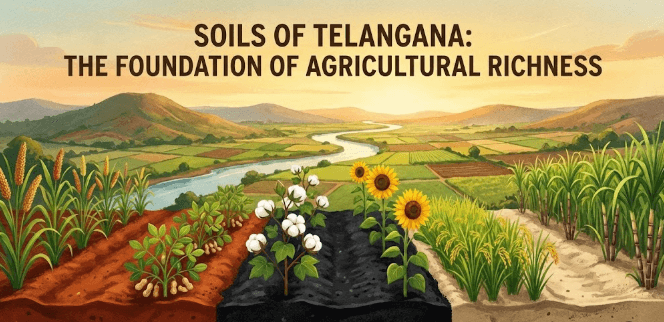
Telangana lies on the Deccan Plateau, a region shaped by ancient volcanic activity and centuries of weathering. Its soils have developed from basaltic rocks, granite-gneiss formations, alluvial deposits, and tropical weathering, creating distinct soil types across the state. Understanding these soils is essential for TSPSC, UPSC, and Groups exams because questions often test soil types, characteristics, district-wise distribution, crop suitability, fertility issues, and conservation measures.
This comprehensive guide covers all major soil types in Telangana, explained through exam-oriented tables, district mapping, and clear conceptual notes.
Introduction: Why Study Soils in Telangana?
Telangana’s agriculture is deeply tied to its soils. The state experiences semi-arid climate, monsoon-dependent rainfall, and relies heavily on irrigation and tank systems. Soil types influence:
- Crop selection (cotton, paddy, millets, pulses, horticulture)
- Fertilizer use
- Water retention & irrigation needs
- Soil conservation programs
- Regional agricultural planning
For competitive exams, “Soils of Telangana” appears under Geography, Economy, Environment & Agriculture.
Major Soil Types in Telangana
According to Telangana State Agriculture Department & Indian Council of Agricultural Research (ICAR), the primary soil types are:
- Red Soils (largest area)
- Black Cotton Soils (Regur)
- Alluvial Soils
- Lateritic Soils
- Sandy / Forest / Hill Soils (minor category)
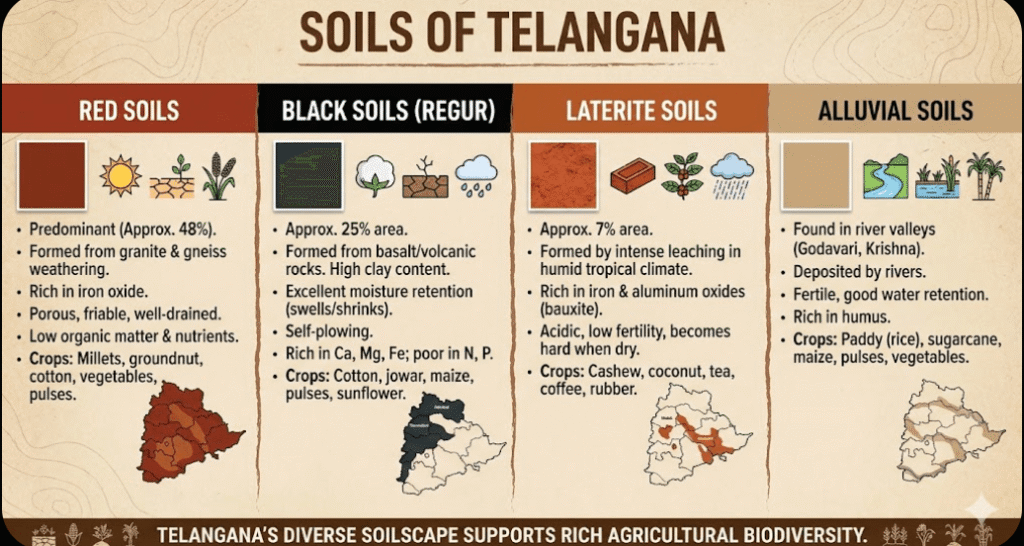
Overview Table — Soil Types, Districts & Crops
| Soil Type | Major Districts | Characteristics | Suitable Crops |
|---|---|---|---|
| Red Soils | Nalgonda, Mahabubnagar, Sangareddy, Warangal, Karimnagar, Khammam | Low humus, porous, quick drainage | Groundnut, millets, pulses, castor |
| Black Cotton Soils | Adilabad, Nizamabad, Karimnagar, Khammam, Warangal Rural | High clay, deep cracks, retains moisture | Cotton, chilli, maize, soybean |
| Alluvial Soils | Bhadradri Kothagudem, Khammam, Nalgonda, Suryapet | Fertile, silty, light-textured | Paddy, sugarcane, vegetables |
| Lateritic Soils | Bhadradri Kothagudem, Khammam forest areas | Iron-rich, acidic, low fertility | Cashew, upland crops |
| Forest / Hill Soils | Adilabad, Asifabad, Kothagudem agency areas | Shallow, gravelly, low nitrogen | Minor millets, forest vegetation |
Red Soils in Telangana (Most Widespread)
Red soils dominate Telangana due to granite weathering and semi-arid climatic conditions.
Characteristics
- Reddish color from iron oxides
- Low in nitrogen, phosphorus, humus
- Good aeration but poor moisture retention
- Medium fertility
District-Wise Distribution
Red soils are dominant in:
- Nalgonda
- Mahabubnagar
- Sangareddy
- Medak
- Warangal
- Karimnagar (parts)
- Khammam (dry tracts)
- Rangareddy
Suitable Crops
- Groundnut
- Red gram, green gram
- Jowar, bajra
- Castor
Image Suggestions
- Map showing dominant red soil belts in central & southern Telangana
- Red loamy soil field photos (generic agriculture stock images)
Black Cotton Soils (Regur) — Telangana’s Cotton Belt
Black soils originate from Deccan Trap basalt, giving Telangana fertile cotton-growing zones.
Characteristics
- High clay content
- Swells with water; forms deep cracks when dry
- Excellent moisture retention
- Rich in calcium, magnesium
- Poor drainage → waterlogging risk
District-Wise Distribution
Major black soil districts:
- Adilabad
- Nizamabad
- Karimnagar (major portions)
- Warangal Rural
- Khammam
These districts form Telangana’s cotton corridor.
Suitable Crops
- Cotton (primary crop)
- Soybean
- Maize
- Chilli
- Turmeric
Image Suggestions
- Black soil profile cut
- Cotton field in black-soil district (Adilabad/Karimnagar)
Alluvial Soils — Riverine & Fertile
Alluvial soils occur along major rivers — Godavari & Krishna — and their floodplains.
Characteristics
- Light-textured, sandy & silty
- Good fertility
- Highly suitable for irrigation agriculture
- Fast nutrient depletion if unregulated
District-Wise Distribution
Alluvial soils are found in:
- Bhadradri Kothagudem (Godavari basin)
- Khammam
- Nalgonda (Krishna floodplains)
- Suryapet
Suitable Crops
- Paddy
- Sugarcane
- Vegetables
- Plantations (banana, turmeric)
Image Suggestions
- Krishna river floodplain farmland
- Alluvial soil texture comparison chart
7. Lateritic Soils — Weathered, Iron-Rich
Lateritic soils form due to intense leaching under high rainfall in forest belts.
Characteristics
- Red or yellowish-brown
- Rich in iron, aluminium
- Acidic
- Low fertility
- Requires fertilizers & organic matter
District-Wise Distribution
Primarily in forest & high rainfall pockets of:
- Bhadradri Kothagudem
- Khammam (Agency/tribal areas)
Suitable Crops
- Cashew
- Tapioca
- Upland millet varieties
8. Forest / Hill / Skeletal Soils
These are shallow, coarse, gravelly soils formed in hilly regions.
Characteristics
- Poor fertility
- Rapid runoff
- Low water retention
District-Wise Distribution
Found in:
- Adilabad & Asifabad (hilly tracts)
- Bhadradri Kothagudem (forest hills)
- Tendu, bamboo & forest vegetation zones
Suitable Crops
- Minor millets
- Forest-based crops
- Horticulture (in pockets)
Full District-Wise Soil Distribution in Telangana
Here is the exam-focused district mapping:
| District | Dominant Soil Type(s) |
|---|---|
| Adilabad | Black, Forest/Hill soils |
| Komaram Bheem (Asifabad) | Forest & Hill soils, Black patches |
| Nirmal | Red soils, some Black soils |
| Nizamabad | Black cotton soils |
| Jagtial | Red + Black soils |
| Rajanna-Sircilla | Red soils |
| Karimnagar | Black soils (dominant), Red soils (east) |
| Peddapalli | Red soils |
| Mancherial | Red and alluvial (Godavari basin) |
| Jayashankar Bhupalpally | Red & forest soils |
| Warangal Urban | Red soils |
| Warangal Rural | Black + Red soils |
| Mahabubabad | Red soils |
| Khammam | Red, Alluvial, Lateritic |
| Bhadradri Kothagudem | Alluvial, Lateritic, Forest soils |
| Suryapet | Alluvial + Red soils |
| Nalgonda | Red, Alluvial soils |
| Yadadri-Bhongir | Red soils |
| Rangareddy | Red soils |
| Hyderabad | Urban alluvial deposits (minor) |
| Medchal-Malkajgiri | Red/alluvial mixes |
| Sangareddy | Red soils |
| Medak | Red soils |
| Siddipet | Red soils |
| Kamareddy | Red soils |
| Mahabubnagar | Red soils |
| Nagarkurnool | Red soils |
| Wanaparthy | Red soils |
| Narayanpet | Red soils |
Conclusion
Telangana’s soils reflect its geological diversity — basaltic plateaus, granitic uplands, forest tracts, and riverine floodplains. Understanding soil types, district distribution, characteristics, crop suitability, and fertility issues is essential for both exam preparation and agricultural planning.