
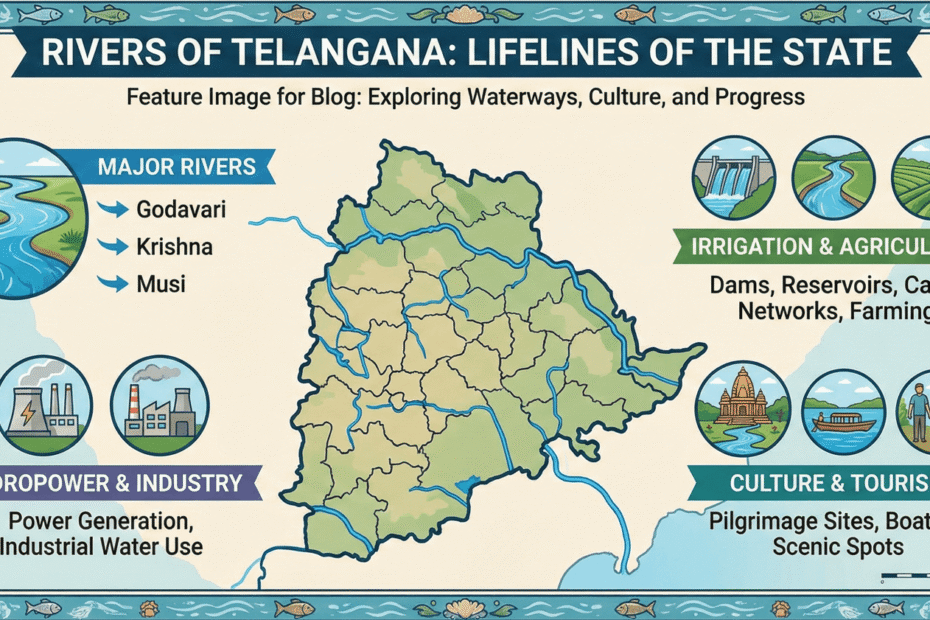
Telangana, located on the Deccan Plateau, is drained mainly by two east-flowing river systems — the Godavari and the Krishna. Although the state has a semi-arid climate, these rivers and their tributaries are crucial for irrigation, drinking water, hydro-projects and cultural life. Competitive-exam questions typically target origins, tributaries, basins, districts crossed, important dams/projects, and environmental issues. This article gives a complete, accurate, and exam-ready view of Telangana’s rivers, with tables, project names and concise exam points.
Overview of River Systems in Telangana
- Major basins: Godavari Basin (covers northern & central Telangana) and Krishna Basin (covers southern Telangana).
- Flow direction: Both systems flow eastwards into the Bay of Bengal.
- Nature of rivers: Largely rain-fed with strong seasonal variation; many tributaries originate within Telangana or neighboring states (Maharashtra, Karnataka).
- Urban significance: The Musi flows through Hyderabad; several reservoirs supply city water.
Major Rivers of Telangana
| River / Tributary | Origin | Telangana Districts (major) | Joins / Empties |
|---|---|---|---|
| Godavari | Trimbak (Nasik, MH) | Nizamabad, Nirmal, Mancherial, Bhadradri Kothagudem | Bay of Bengal |
| Krishna | Mahabaleshwar (MH) | Narayanpet, Mahbubnagar, Nalgonda, Suryapet | Bay of Bengal |
| Pranahita | Confluence of Wardha & Wainganga | Forms TS–MH border (Adilabad area) | Godavari |
| Penganga | Maharashtra (flows along TS–MH border) | Adilabad border areas | Joins Wardha → Pranahita |
| Manjira | Balaghat Range (MH) | Sangareddy, Medak, Rangareddy | Godavari |
| Manair / Maneru | Sircilla region (TS) | Rajanna-Sircilla, Karimnagar | Godavari |
| Kinnerasani | Eastern Ghats foothills | Bhadradri Kothagudem | Godavari |
| Kadam | Adilabad region | Nirmal, Adilabad | Godavari |
| Musi | Ananthagiri Hills (Vikarabad) | Hyderabad, Rangareddy | Krishna |
| Bhima | Bhimashankar (MH) | Vikarabad / border areas | Krishna |
| Dindi | Nalgonda hills (TS) | Nalgonda | Krishna |
This table covers all major rivers relevant for exams and geography—complete and accurate.
Godavari River – The Largest River System in Telangana
Why it matters: The Godavari Basin covers the largest area of Telangana. It supports major irrigation projects and provides riverine ecosystems in the north and central districts.
Origins & course: Godavari originates in Trimbak (Nasik), Maharashtra and flows eastward through northern Telangana. Notable Telangana districts along or influenced by the Godavari include Nizamabad, Nirmal, Mancherial and Bhadradri Kothagudem.
Key Facts
- Origin: Trimbak (Nasik), Maharashtra
- Enters Telangana near Basar
- Districts: Nizamabad, Nirmal, Mancherial, Bhadradri Kothagudem
- Important for agriculture and irrigation projects
- Hosts cultural sites like Basar Saraswathi Temple
Major Godavari Tributaries in Telangana
- Pranahita River
- Penganga River
- Manjira River
- Manair (Maneru) River
- Kadam River
- Kinnerasani River
This makes Godavari the largest river network in the state.
Important Tributaries of Godavari (Detailed Sections)
Key tributaries (Telangana-relevant):
- Pranahita: Huge volume; formed by Wardha + Wainganga; important in northern water balance.
- Penganga: Flows along the TS–MH border; eventually reaches Pranahita.
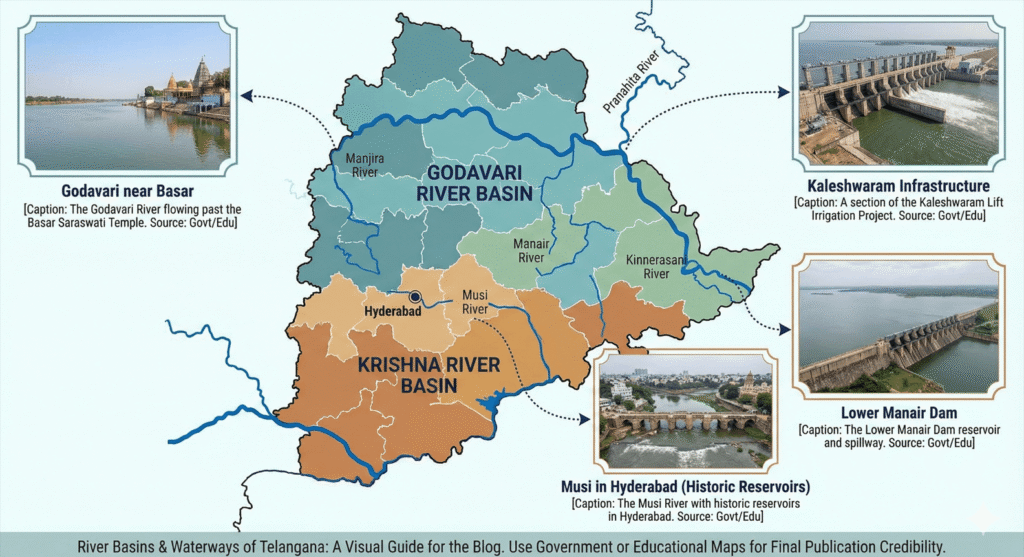
- Manjira: Supplies Hyderabad (Singur/Singoor/Singur Reservoir) and Sangareddy/Medak areas.
- Manair (Maneru): Important for Karimnagar & Sircilla; Lower Manair Dam (LMD) is a notable structure.
- Kinnerasani: Flows in Bhadradri Kothagudem (Kinnerasani Dam supports local irrigation/wetlands).
- Kadam: Contains the Kadam Project reservoir in Adilabad/Nirmal environs.
Major project: Kaleshwaram Lift Irrigation Project (KLIP) — an ambitious, multi-stage lift project (Godavari basin) designed to irrigate large areas and supply water; frequently asked in exams.
Krishna River – The Major River of Southern Telangana
Overview: Krishna originates in Mahabaleshwar (MH) and its basin includes southern Telangana districts such as Narayanpet, Mahbubnagar, Nalgonda and Suryapet.
Important tributaries in Telangana:
- Musi: Originates in Ananthagiri Hills; flows through Hyderabad; historically caused the 1908 floods; currently faces severe pollution and encroachments (Osmansagar & Himayatsagar are historical reservoirs supporting Hyderabad).
- Bhima: Enters Telangana at Vikarabad border area; contributes to Krishna flows in lean/rainy seasons.
- Dindi: Supports lift irrigation projects (Dindi Lift Scheme) and local irrigation in Nalgonda.
Major projects: Nagarjuna Sagar (on Krishna) and Srisailam are major reservoirs impacting the region’s water resources. Nagarjuna Sagar’s canals and reservoirs are repeatedly examined in water-resource questions.
Importance: Economy, Agriculture & Urban Supply
Irrigation: Rivers enable canal systems, reservoirs and lift irrigation (Kaleshwaram on Godavari; Dindi & other schemes on Krishna). Paddy, cotton, maize and horticulture depend on these systems.
Drinking water: Manjira (Singur) supplies Hyderabad; Krishna pipelines and inter-basin links supply southern districts and urban centers.
Fisheries & livelihoods: Riverine wetlands and reservoirs support inland fisheries and seasonal livelihoods.
Cultural: Temples and ghats along Godavari (e.g., Basar) and river-linked festivals form part of Telangana’s heritage.
River Basins in Telangana
| Basin | Rivers Included | Notes |
|---|---|---|
| Godavari Basin | Godavari, Pranahita, Manjira, Penganga, Kadam, Manair, Kinnerasani | Largest part of Telangana’s drainage |
| Krishna Basin | Krishna, Musi, Bhima, Dindi | Crucial for southern Telangana agriculture |
Importance of Rivers in Telangana
1. Irrigation
- Support lift irrigation and canal networks
- Vital for paddy, cotton, maize cultivation
- Major projects like Kaleshwaram and Nagarjuna Sagar
2. Drinking Water
- Manjira River → Hyderabad
- Krishna → major pipeline projects
3. Economy & Agriculture
- Stabilizes rural livelihoods
- Supports fishing, sand mining (regulated), tourism
4. Ecology
- Maintains wetlands, forests, riparian ecosystems
5. Culture & Heritage
- Temples along Godavari
- Sacred ghats & festivals
Environmental Challenges
1. Pollution
- Musi River is one of the most polluted rivers in India
- Industrial waste affects tributaries near towns
2. Seasonal Flow Variation
- Heavy dependence on monsoons
- High evaporation due to plateau climate
3. Encroachment
- Urban expansion shrinking riverbeds
- Loss of wetlands
4. Inter-State Water Disputes
- Krishna and Godavari allocations with AP, Karnataka, Maharashtra
Major Water Projects in Telangana
Godavari System
- Kaleshwaram Lift Irrigation Project
- Lower Manair Dam
- Kadam Project
- Kinnerasani Dam
Krishna System
- Nagarjuna Sagar Project
- Srisailam Left Bank Canal
- Dindi Lift Irrigation Scheme
Conclusion
Telangana’s rivers (Godavari, Krishna and their tributaries such as Pranahita, Penganga, Manjira, Manair, Kinnerasani, Musi, Bhima and Dindi) form the backbone of the state’s hydrology and economy. For exam aspirants, prioritize origins, tributary relationships, districts crossed, major dams/projects, and current environmental issues (Musi pollution, inter-state sharing, Kaleshwaram).
Frequently Asked Questions
How many major river basins are in Telangana?
Two — Godavari and Krishna.
Which is the largest tributary of Godavari in Telangana?
Pranahita River.
Which river flows through Hyderabad?
Musi River.
Manjira River is a tributary of?
Godavari River.
Which major project is built on Krishna?
Nagarjuna Sagar Project.