
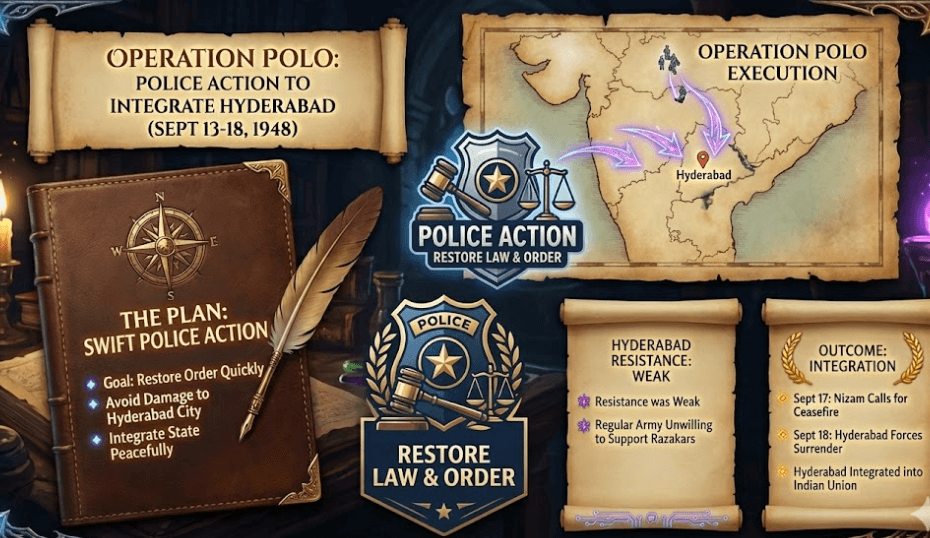
Operation Polo was a military action carried out by the Government of India in September 1948 to bring Hyderabad State into the Indian Union. The operation lasted only five days (13–18 September 1948), but its impact on Telangana and Indian history has been deep and long-lasting.
What was Operation Polo?
Operation Polo is also known as the Hyderabad Police Action. It was conducted by the Indian Army to restore order and integrate Hyderabad State into India after failed negotiations with its ruler.
- Key facts:
- Duration: 5 days
- Year: 1948
- Result: Hyderabad merged with India
Hyderabad’s situation after independence (1947–48)
After India gained independence in 1947, princely states had to join India or Pakistan. Hyderabad, ruled by Mir Osman Ali Khan, chose to remain independent.
This created serious issues:
- Hyderabad was surrounded by Indian territory
- Trade, transport, and communication depended on India
- Internal instability increased rapidly
India viewed Hyderabad’s independence as a threat to national unity.
Law and order problems inside Hyderabad
By 1948, Hyderabad was already unstable.
Problems included:
- Weak administration in rural areas
- Peasant uprisings in Telangana
- Loss of government control in many districts
This internal breakdown is often ignored but was a major reason behind Operation Polo.
Razakars: a rarely explained factor
The Razakars were a private militia loyal to the Nizam and led by Qasim Razvi. They were not part of the official Hyderabad army, but they exercised enormous power.
Their actions included:
- Forcing loyalty through fear
- Attacking political opponents
- Targeting civilians in villages
Even senior officials of Hyderabad were afraid of the Razakars. Their uncontrolled violence weakened the Nizam’s authority and reduced international sympathy for Hyderabad. This factor is critical but often underplayed in popular narratives.
Why India called Operation Polo a “police action”
India deliberately avoided calling Operation Polo a war. Instead, it described it as a police action.
This wording was important because:
- Hyderabad was legally within India’s territory
- India wanted to show it was restoring order, not invading
- It reduced pressure from international bodies like the United Nations
This diplomatic strategy helped India act decisively while avoiding global backlash.
How Operation Polo was planned and executed
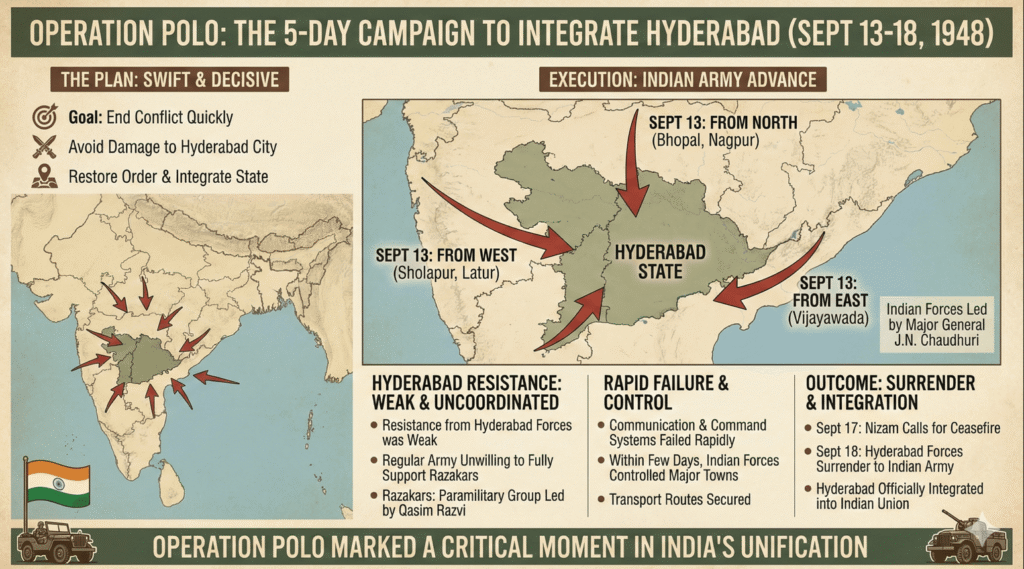
The Indian Army entered Hyderabad on 13 September 1948 from several directions. The plan was to end the conflict quickly and avoid damage to Hyderabad city.
During the operation:
- Resistance from Hyderabad forces was weak and uncoordinated
- The regular army was unwilling to fully support the Razakars
- Communication and command systems failed rapidly
Within a few days, Indian forces controlled major towns and transport routes, making further resistance
impossible.
The surrender that prevented heavy destruction
A rarely mentioned but important figure is S. A. El Edroos, the commander of Hyderabad’s forces.
He realized that:
- Continuing the fight would only harm civilians
- Hyderabad city could face destruction
- The state had already lost control
On 18 September 1948, he ordered a surrender. This decision avoided a long conflict and saved thousands of lives, yet it is often missing from public discussions.
Civilian violence after the operation
The most painful part of Operation Polo occurred after the fighting ended. In several districts, communal violence broke out, and civilians were killed.
To investigate these events, the Indian government appointed the Sunderlal Committee.
Key findings included:
- Violence was widespread but uneven
- Most deaths occurred after surrender
- Estimated civilian deaths ranged between 30,000–40,000
The report remained unpublished for decades, which is why this tragedy is still not widely known.
What happened to the Nizam after 1948
Contrary to popular belief, the Nizam was not arrested or exiled.
After Operation Polo:
- He was allowed to remain as a ceremonial head (Rajpramukh)
- His political powers were removed gradually
- His wealth and privileges were reduced over time
This approach helped India maintain stability and prevent rebellion during the transition.
Long-term impact of Operation Polo on Telangana
Operation Polo marked the end of feudal Nizam rule and the beginning of administrative integration with India.
Its long-term effects on Telangana included:
- Changes in land ownership
- New governance and legal systems
- Rise of political awareness and movements
Many later struggles for land rights, development, and statehood were shaped by the changes that began in 1948.
Operation Polo was a short military action with deep and lasting consequences. It integrated Hyderabad into India and reshaped Telangana’s future. At the same time, it involved serious human suffering that should not be ignored.
A balanced and honest understanding of Operation Polo is essential to understand both Telangana’s past and India’s early years after independence.