
Vegetation of Telangana refers to the natural plant cover found across the state, influenced mainly by climate, rainfall, soil, and relief. Telangana lies on the Deccan Plateau, experiencing a tropical semi-arid climate, which supports mainly dry deciduous and thorn forests.
Understanding the vegetation of Telangana is important for:
- School & competitive exams
- Geography and environment studies
- Telangana GK and state-level awareness
What is the Vegetation of Telangana?
The vegetation of Telangana mainly consists of dry deciduous and thorn forests because the state has:
- Semi-arid climate
- Moderate to low rainfall
- Deccan Plateau relief
The vegetation of Telangana is mainly tropical dry deciduous and tropical thorn forests due to its semi-arid climate and moderate rainfall.
Forest Cover in Telangana
Telangana has a moderate forest cover, concentrated mainly in the northern and southern districts.
- Forest area: Around 24% of the state’s geographical area
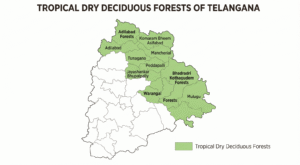
- Dense forests are found in Adilabad, Bhadradri Kothagudem, Mulugu, Warangal, and Khammam
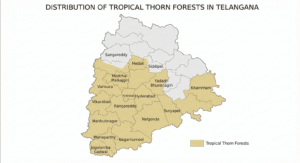
- Sparse vegetation is common in central and southern regions
Types of Vegetation in Telangana
Based on climate and rainfall, the vegetation of Telangana can be broadly classified into three main types.
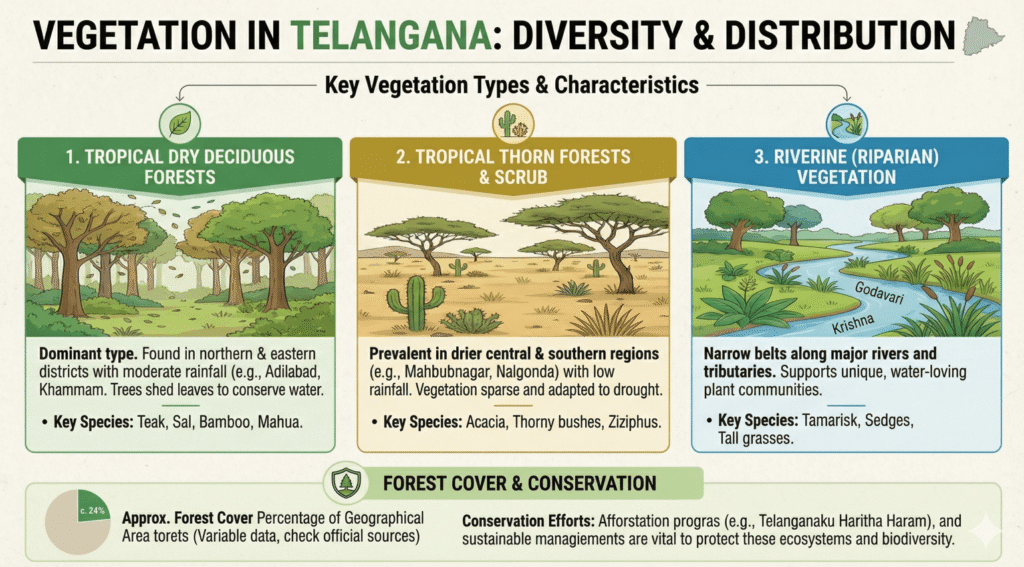
- Tropical Dry Deciduous Forests
- Tropical Thorn Forests
- Riverine and Grassland Vegetation
Tropical Dry Deciduous Forests
Dry deciduous forests are the most common forests in Telangana. Trees shed their leaves during the dry season to reduce water loss. These forests grow in areas with moderate rainfall. Teak, bamboo, neem, and tendu are important trees found in these forests.
Tropical Thorn Forests
Tropical thorn forests are found in low rainfall and dry regions of Telangana. Trees and shrubs are short, scattered, and thorny to reduce loss of water. Leaves are small or modified into spines. Acacia, cactus, date palm, and euphorbia are common plants found in these forests.
Riverine and Grassland Vegetation
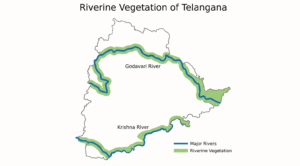
Riverine vegetation grows along the banks of rivers, while grasslands are found in open plains of Telangana. This vegetation depends on river water and seasonal floods. Tall grasses and moisture-loving trees are common. Banyan, tamarind, arjun tree, and grasses are found in this vegetation.
Importance of Vegetation
Vegetation is important because it:
- Prevents soil erosion
- Supports wildlife
- Maintains ecological balance
- Improves rainfall and groundwater
Conclusion
The vegetation of Telangana is mainly influenced by its semi-arid climate, moderate rainfall, and plateau relief. The state is dominated by tropical dry deciduous forests, along with tropical thorn forests in low rainfall areas and riverine vegetation along major rivers. These forests provide important resources such as timber, bamboo, and minor forest produce, and also help in maintaining ecological balance. Proper conservation of vegetation is essential for environmental protection and sustainable development in Telangana.
-
Why does Telangana have dry deciduous forests?
Telangana has dry deciduous forests because it experiences a semi-arid climate with seasonal rainfall. Due to long dry periods, trees shed their leaves to conserve water, which is a characteristic feature of dry deciduous vegetation.
-
Is vegetation of Telangana important for competitive exams?
Yes, the vegetation of Telangana is an important topic for Class 6–10 exams, state board exams, and Telangana-based competitive exams, especially in geography and environment sections.